Fungal infections
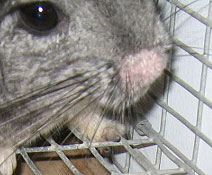
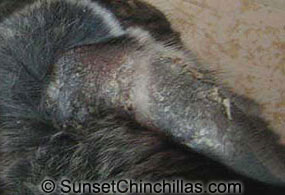
Bottom: Hair loss from attack. Not fungus.
The text from this page was used and published in several veterinary medical reference books. I am not a vet and I am not a scientist so your mileage may vary with this information. Because of this vets are recommending people use captan inside their homes and it is a known carcinogen. Chins live long enough to get cancer and so do the humans that touch and play with them. Please, unless you can find nothing else, do not use Captan on anything.
Fungus is not very fun, I did not have an occurance of it until my 5th year of breeding in 2004. It spreads quickly and is a pain to get rid of. Most often it occurs when you have a damp year, poor air circulation or stressed animals. In the case above, this male had contracted it as a youngster in the breeder's herd, and the stress of a new home (and unusually wet year) caused him to have an outbreak at my place. He spread it to a good 1/3 of my herd, many of which had absolutely no contact with each other. I simply assume they were also stressed by the unusal storms and chaos of rearranging the room at the time.
Information about ringworm or 'Dermatophytes'
Ringworm travels via spores and is found in soils worldwide. It has thousands of different strains and some can be carried and only appear under severe stress. Others are not transferable between species and do not affect humans. Each outbreak is different, some types can be seen with a blacklight, some can not. Some strains are also known to be a systematic infection and may need antibiotics to help get rid of it.
Getting rid of Ringworm;
Over the counter medications do not kill fungus. They inhibit it from growing so over the course of 6-8 weeks your immune system takes care of it naturally. You need to remember that the currently infected area is the crust or ring around the bald patch it causes so when using a cream (not recommended for chins) make sure you smear it a good 1/4-1/2" outside of the patch you see. I used Lamotrin when I got it in 2004. Strangely enough I got it in the middle of my back two months after the first outbreak in an area that the chins had no contact with. It took the full 6 weeks to go away. Edit 9/2012 - I now know that this ringworm was from working at the vet hospital. The ringworm that the chinchillas get is not passable to humans or other animals that I am aware of and if anyone has any experiences with this, please email me. They can still get different strains from cats, dogs and humans.
If you only have one chin and are not worried about it spreading, you can use Tinactin or an equivalent powder in the dust bath daily. Make sure to use new dust and wash the container frequently. I'd say do it every time, but if you are not sterilizing the cage every time the chin dusts it defeats the purpose.
There are a couple of ways to get rid of fungus in your herd. The preferred and safest option is to use sulfer (flowers of sulfur) in the dust bath. Powdered sulfur is used in making soap and absorbing/neutrilizing chemicals and can be found at old-time drug stores or ranch supply stores. I've found it to be very effective without the hazards of Captan. I mix it 1TBS to a pound of dust. It is very safe and can be eaten. It is routinely used on horses and dogs as an antifungal. Some breeders also use blue-kote but I have never tried it.
The other product is Captan, it is illegal in some states so it may not be available to you. I used it on my animals the second year before I knew about sulfur. It kills the fungus immediately and if you keep the environment clean you will see fur re-growth within 3 to 5 days. Captan is a known carcinogen and I do not recommend using it However, in some places this is all you can get.
Captan has several downsides; It is a known carcinogen, it can be fatal, and in the type I used (Captan WP/50) will cause irreversible eye damage as well as skin lesions a multitude of other issues. I diluted it to 5% (2.5 cups dust to 1 tsp. Captan) and wore protective gear. I did not enter the room for a couple hours afterwards, left the window open and my HEPA filter and fans going. It did its job. I would not recommend using it in your house.
Notes in 2012
I've been using a stall freshener called SweetPDZ in the cages to help keep my pans from rusting and the chinchillas love to dust in it. It appears to have some anti fungal effects as well though I do not know why.